Velouté Sauce
Velouté is a light stock thickened with a blonde roux. It’s the quietest of the five mother sauces — no cheese, no tomato, no egg yolks, just stock and roux working together. And it’s the base for some of the most useful sauces in Western cooking: chicken supreme, mushroom sauce, and the gravy that makes a proper pot pie taste like more than chicken and peas. It takes about 20 minutes once you have stock on hand.
Makes: About 2 cups
Prep time: 5 minutes
Cook time: 15–20 minutes
Total time: 20–25 minutes
Difficulty: Easy
Cuisine: French
Category: Mother sauce
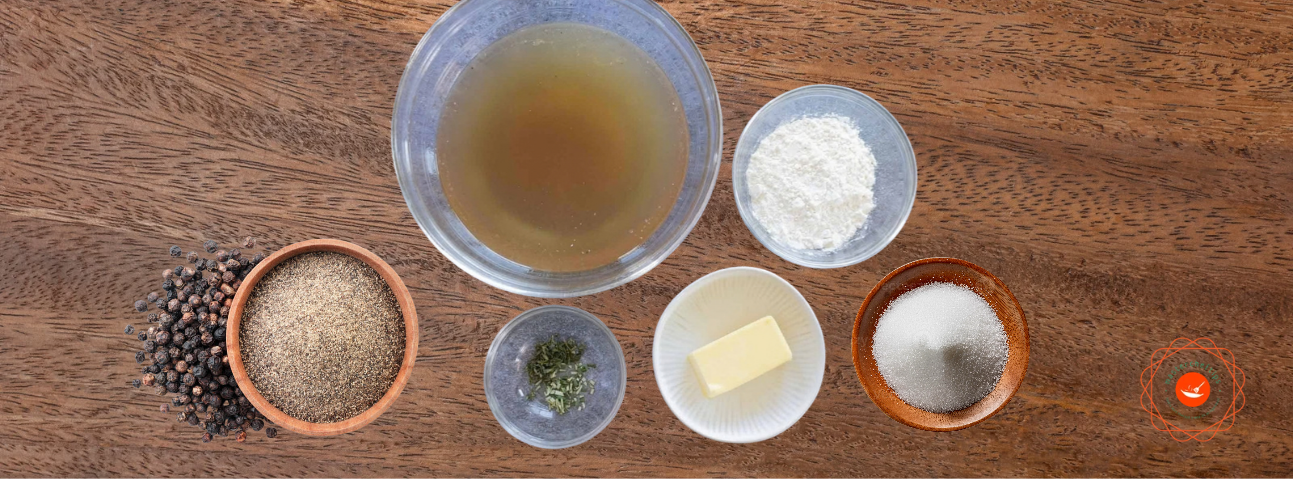
Table of Contents
ToggleIngredients
2 cups light stock — chicken, veal, or fish (see note below)
3 tablespoons unsalted butter
3 tablespoons all-purpose flour
1/4 teaspoon fine salt
1/8 teaspoon white pepper
Optional: a few sprigs of fresh thyme or a bay leaf
A note on the stock. The stock is the whole sauce. A velouté made with weak or watery stock tastes like thickened water. If you make your own stock, you already have the best version. If you’re buying it, buy the best unsalted or low-sodium stock you can find.
Instructions
1. Make the roux. In a heavy-bottomed saucepan, melt the butter over medium-low heat. When the foaming stops, add the flour all at once and whisk constantly for 1 to 2 minutes. The roux should look like wet sand and smell faintly nutty. Keep it blonde — don’t let it brown. A browned roux makes espagnole, not velouté.
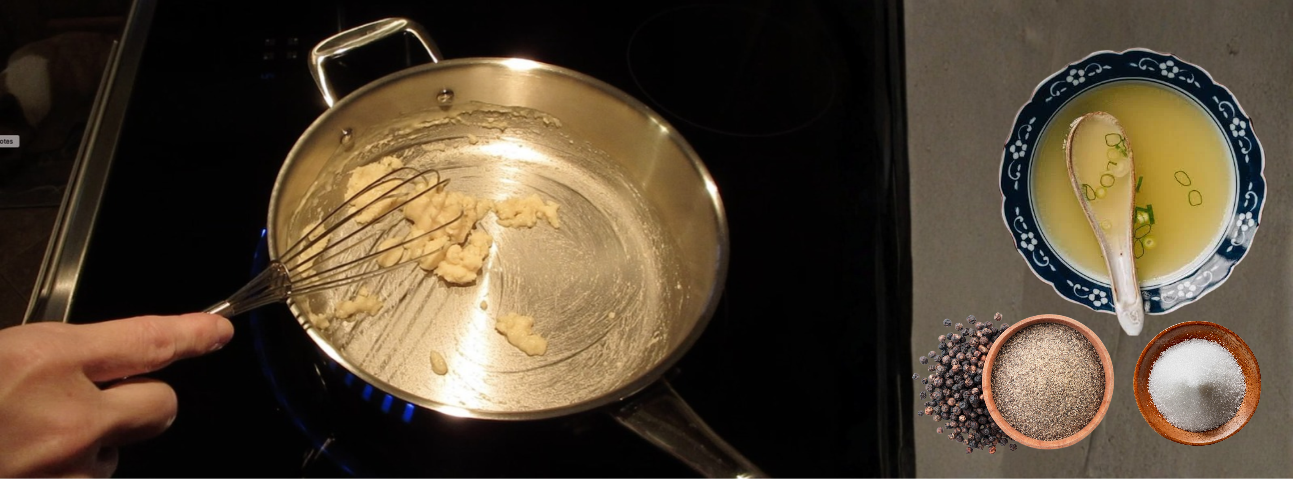
2. Add the stock — slowly. Pour the warm stock into the roux in a slow, steady stream, whisking constantly. Don’t dump it in all at once. Add some, whisk until smooth, add more, whisk again. The sauce will look like thick paste at first, then loosen into a thin sauce as you add more stock.
3. Simmer until thickened. Bring the sauce to a bare simmer — small bubbles breaking at the surface, not a boil. Cook for 10 to 15 minutes, whisking occasionally, until the sauce coats the back of a spoon. This is longer than béchamel needs, because velouté has to reduce enough to concentrate the stock flavor.
4. Season. Add salt, white pepper, and a few sprigs of thyme or a bay leaf if you have them. Simmer for another 2 minutes. Fish out the herbs before serving.
5. Strain (optional but recommended). For a restaurant-smooth velouté, pass the sauce through a fine-mesh sieve. This removes any lumps and gives you a perfectly silky finish.
6. Use or store. Use immediately, or cool and refrigerate.

Chicken, Veal, or Fish — Pick Your Base
Velouté is always built on a light stock. The stock you choose determines the sauce you make.
Chicken velouté — the most common. Made with chicken stock. Used for chicken supreme, mushroom sauce, and gravies for poultry and pork.
Veal velouté — richer, deeper. Made with white veal stock. Used for the base of allemande and other classical French sauces for veal and beef.
Fish velouté — delicate. Made with fish stock. Used for seafood sauces, especially for poached or grilled fish.
If you’re only going to make one, make chicken velouté. It’s the most versatile.
The Two Methods for making Roux
Method 1 — Hot roux, warm stock
Make the roux in a pan, then pour in the warm stock slowly while whisking. This is the method most home cooks use. It’s straightforward and works well on a weeknight.
Method 2 — Cool roux, hot stock
Make the roux in one pan and let it cool slightly. Heat the stock in a separate saucepan with the salt, pepper, and herbs. Let the herbs infuse into the stock for a few minutes. Then whisk the hot seasoned stock into the cool roux, slowly.
Chef’s note: This is the classical French method. A cool roux absorbs hot stock more evenly and produces a smoother sauce with less whisking. It’s also more aromatic because the herbs infuse the stock before the roux is added.
The Gluten-Free Version
You don’t need a roux to make velouté. Potato starch or cornstarch will thicken the stock just as well, and the result tastes almost identical.
How to do it:
Skip the butter and flour entirely. Bring the stock to a simmer with the salt, pepper, and herbs. In a small bowl, whisk 2 tablespoons of potato starch (or cornstarch) with 2 tablespoons of cold water to make a slurry. Whisk the slurry into the simmering stock. Cook for 2 to 3 minutes, whisking constantly, until the sauce thickens. Strain if needed.
Chef’s note: Cornstarch and potato starch thicken more aggressively than flour. Start with less than you think you need and add more if the sauce is too thin. The finished sauce is slightly more glossy than a roux-thickened velouté, and it doesn’t reheat quite as well — it tends to thin out.
The Ratio
Once you know the ratio, you don’t need the recipe.
Thin velouté: 1 tablespoon butter, 1 tablespoon flour, 1 cup stock. Use for soups and light sauces.
Medium velouté: 2 tablespoons butter, 2 tablespoons flour, 1 cup stock. Use for the base of most sauces.
Thick velouté: 3 tablespoons butter, 3 tablespoons flour, 1 cup stock. Use for binding, or for sauces that need to hold their shape.
Learn it as one-one-one, two-two-one, three-three-one. Same pattern as béchamel.
Why It Works
Flour is mostly starch. When starch meets hot liquid, the granules swell and burst, releasing molecules that thicken the stock. The roux exists because raw flour clumps when it hits liquid. Coating the flour in fat first separates each granule, so when the stock arrives, they hydrate individually instead of in clumps.
Three things break the sauce:
Stock added too fast seizes the flour into lumps.
Undercooked roux leaves raw flour that tastes like paste.
Boiling the sauce scorches the starch and gives it a burnt edge.
The difference between velouté and béchamel is what you’re thickening: béchamel thickens milk, velouté thickens stock. Both use the same roux and the same technique.
What You Can Make With It
Add one ingredient and you have another sauce. This is why velouté is a mother sauce — it’s the base for a whole family of classical French sauces.
Cream → supreme sauce. Chicken, veal, vegetables.
Mushroom cooking liquid → mushroom sauce. Chicken, veal, pasta.
Egg yolks + cream → allemande sauce. Veal, chicken, vegetables.
White wine + shallots + cream → white wine sauce. Fish, chicken.
Reduced veal stock + tomato → the base for demi-glace (with espagnole).
Fresh herbs → herb velouté. Fish, chicken, vegetables.
Lemon juice + butter → a quick sauce for poached fish.
Curry powder → curry velouté. Chicken, fish, vegetables.
Most of these dishes also start with meat that’s been seared or poached — the sauce goes on top.
Recipe Notes
Using stock cubes. A stock cube will technically work, but the sauce will taste like a stock cube. Use real stock if you can.
Substituting flour. For a gluten-free velouté, use potato starch or cornstarch. Use half the amount and skip the roux step entirely — see the gluten-free section above.
Fixing lumps. Pass the sauce through a fine-mesh sieve into a clean pan and keep going. Nothing is lost.
Fixing a scorched bottom. Pour the sauce into a clean pan and leave the burnt layer behind. Don’t scrape — the burnt taste will follow.
Making it richer. A small knob of cold butter whisked in at the end gives the sauce a glossier finish. This is called monter au beurre — finishing with butter.
Straining matters. Velouté is meant to be silky. If you have the time, strain it before serving.
Storage
Fridge: Up to 3 days in an airtight container, with plastic wrap pressed directly onto the surface.
Freezer: Up to 2 months. Thaw overnight in the fridge, then reheat gently with a splash of stock.
Reheating: Low heat, whisking occasionally. Don’t boil.
Velouté made with a roux reheats better than velouté made with cornstarch. The roux version holds its texture through reheating; the starch version tends to thin out.
The Takeaway
Velouté is stock and roux. That’s it. Once you know the ratio, you can make it from any light stock you have on hand — chicken, veal, or fish. Once you know what it becomes, you have the base for a dozen classical sauces.
Learn it once and you’ll use it for the rest of your cooking life.