Espagnole Sauce
Espagnole is a brown stock thickened with a brown roux, plus tomato, mirepoix, and a bouquet garni. It’s the darkest and most complex of the five mother sauces — the one that takes the longest, tastes the deepest, and becomes the most things. It’s the base for demi-glace, and demi-glace is the base for a whole family of classical French sauces. The full version takes hours. This version is a home-kitchen shortcut that keeps most of the depth without the all-day cook.
Makes: About 2 cups
Prep time: 15 minutes
Cook time: 30–40 minutes
Total time: 45–55 minutes
Difficulty: Medium
Cuisine: French
Category: Mother sauce

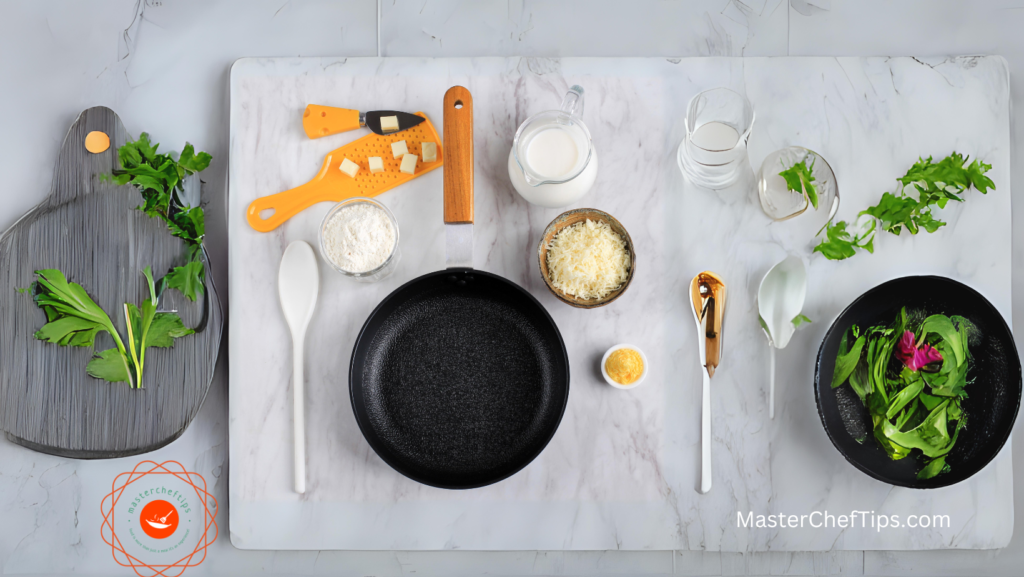
Ingredients
- 2 tablespoons unsalted butter or neutral oil
- 2 tablespoons all-purpose flour
- 1 small onion, finely chopped
- 1 small carrot, finely chopped
- 1 small celery stalk, finely chopped
- 2 cloves garlic, minced
- 1 cup beef or chicken broth
- 1/2 cup canned crushed tomatoes
- 1 bay leaf
- 1/2 teaspoon dried thyme
- Salt and pepper to taste
A note on the ingredients. The quality of what goes in determines what comes out. A weak broth makes a weak sauce. Canned tomatoes that taste flat make a sauce that tastes flat. Use the best stock and tomatoes you have.
Instructions
1. Brown the vegetables. Melt the butter or heat the oil in a saucepan over medium heat. Add the onion, carrot, celery, and garlic. Cook for 5 to 7 minutes, until the vegetables are soft and starting to brown.
Chef’s note: Don’t rush this step. The browning on the vegetables is where a lot of the sauce’s depth comes from. Pale vegetables make a pale sauce.
2. Add the flour. Sprinkle the flour over the vegetables and stir well. Cook for 2 to 3 minutes, stirring constantly, until the flour is absorbed and the mixture smells faintly nutty.
Chef’s note: Traditional espagnole uses a brown roux — the flour is cooked until it darkens to a deep brown. This shortcut version keeps the roux lighter because the vegetables are already browned. The result is slightly less intense but much faster. If you want the full classical version, cook the flour-vegetable mixture for another 5 to 10 minutes, until the flour itself darkens.
3. Add the broth and tomatoes. Pour in the broth slowly while stirring continuously to prevent lumps. Add the crushed tomatoes, bay leaf, and dried thyme. Stir to combine.

4. Simmer. Bring to a gentle simmer, then reduce the heat to low. Cook for 20 to 30 minutes, stirring occasionally, until the sauce thickens and the flavors come together.
Chef’s note: If the sauce reduces too much, add a splash of broth or water. If it’s too thin at the end of the cooking time, keep simmering with the lid off.
5. Season. Add salt and pepper to taste. Be careful with the salt — the broth and tomatoes both add sodium. Taste first, then adjust.
6. Strain or leave chunky. For a smooth sauce, strain through a fine-mesh sieve. For a more rustic sauce, leave the vegetables in. Both are correct — it depends on what you’re using it for.
Chef’s note: For a classical espagnole that will become a base for other sauces, strain it. For a sauce you’re serving over meat tonight, leave it chunky.
7. Remove the bay leaf. Before serving, fish out the bay leaf.
8. Use or store. Use immediately, or cool and refrigerate.
A Bit of Background
Espagnole is one of the five mother sauces in classical French cooking, formalized by Auguste Escoffier in the early 20th century. The name sounds Spanish, but it isn’t from Spain — the name refers to the Spanish influence on French cooking at the time the sauce developed.
Traditional espagnole is a long process. It starts with roasted bones, builds a brown stock, thickens it with a brown roux, and adds tomato, mirepoix, and a bouquet garni. It simmers for hours, then gets strained and reduced further into demi-glace. The full version can take the better part of a day.
This recipe is the shortcut. It uses purchased or homemade broth instead of making stock from bones, and it browns the vegetables directly in the pan instead of roasting them separately. The result is not identical to the full classical version — but it’s close enough for most home cooking, and it takes 45 minutes instead of 8 hours.
What Makes It a Mother Sauce
Espagnole is the base for demi-glace, which is the base for most classical French meat sauces. That chain looks like this:
- Espagnole → demi-glace (espagnole + more brown stock, reduced)
- Demi-glace → sauce bordelaise (with red wine and shallots)
- Demi-glace → sauce Robert (with mustard and onion)
- Demi-glace → sauce chasseur (with mushrooms, shallots, white wine)
- Demi-glace → sauce poivrade (with crushed peppercorns)
- Espagnole directly → sauce charcutière (with white wine, mustard, gherkins)
The shortcuts are all the same idea: espagnole plus one or two things, simmered down.
What You Can Make With It
Espagnole is used for:
- Beef Bourguignon — the sauce base for the stew
- Coq au Vin — same idea, with chicken
- Beef stew — adds depth
- Steak — pan-seared steaks finished with espagnole-based sauce
- Pasta — used as a base for hearty meat sauces
- Savory pies — the filling for meat pies and casseroles
- Meatballs — simmered in espagnole instead of tomato sauce
- Braised short ribs — the braising liquid
Most of these dishes also start with meat that’s been seared or browned — the sauce goes on top.
The Ratio
The ratio for espagnole is less about precision than béchamel or velouté — the sauce is forgiving. But the basic ratio is:
- Thin espagnole: 1 tablespoon fat, 1 tablespoon flour, 1 cup stock. Use for soups and light braises.
- Medium espagnole: 2 tablespoons fat, 2 tablespoons flour, 1 cup stock. Use for most meat dishes.
- Thick espagnole: 3 tablespoons fat, 3 tablespoons flour, 1 cup stock. Use for binding, or when the sauce is the star.
Why It Works
Flour is mostly starch. When starch meets hot liquid, the granules swell and burst, releasing molecules that thicken the stock. The roux exists because raw flour clumps when it hits liquid. Coating the flour in fat first separates each granule, so when the stock arrives, they hydrate individually instead of in clumps.
Three things break the sauce:
- Broth added too fast seizes the flour into lumps.
- Undercooked roux leaves raw flour that tastes like paste.
- Boiling the sauce scorches the starch and gives it a burnt edge.
The difference between espagnole and velouté is the base. Velouté uses a light stock and a blonde roux. Espagnole uses a dark stock (or browned vegetables), a brown or semi-brown roux, and tomato. The tomato adds acidity and color; the browned vegetables add the depth that makes espagnole taste “brown.”
Recipe Notes
Using stock cubes. A stock cube will work, but the sauce will taste like a stock cube. Use real stock if you can.
Substituting flour. Cornstarch or potato starch works for a gluten-free version. Use half the amount.
Making it darker. If you want a deeper, more classical flavor, cook the flour and vegetables together longer — up to 10 minutes — until the flour itself darkens to a light brown.
Fixing lumps. Pass the sauce through a fine-mesh sieve into a clean pan. Nothing is lost.
Fixing a scorched bottom. Pour the sauce into a clean pan and leave the burnt layer behind. Don’t scrape.
Reducing for a thicker sauce. If you want a sauce thick enough to glaze meat, simmer it longer with the lid off. This is how you make a shortcut demi-glace.
Straining matters. For a classical sauce, strain it. For a rustic sauce, don’t.
Storage
- Fridge: Up to 4 days in an airtight container, with plastic wrap pressed directly onto the surface.
- Freezer: Up to 3 months. Thaw overnight in the fridge, then reheat gently with a splash of broth.
- Reheating: Low heat, whisking occasionally. Don’t boil.
Espagnole reheats well because of the fat content. It can also be reduced further after reheating if you want a thicker sauce.
The Takeaway
Espagnole is the deepest of the mother sauces. The classical version takes hours, but this home-kitchen version takes 45 minutes and gets you most of the way there.
Make it once, and you have the base for demi-glace, bordelaise, chasseur, and a dozen other classical sauces. It’s the sauce that turns a stew into a French stew, and a steak into a steakhouse plate.