The Chef Who Fixed the Kitchen: How Escoffier Built the Brigade
Before Escoffier, a professional kitchen was chaos.
Not metaphorically. Literally. Cooks shouting at each other. Ingredients going missing. Plates going out cold because nobody knew whose job it was to finish them. A hotel kitchen in 1880 was a room full of talented, exhausted people who couldn’t work together.
Auguste Escoffier fixed it. Not with a new recipe. With a system.
He called it the brigade de cuisine — a hierarchy where every cook had one station, one job, and one person to report to. The saucier made sauces. The poissonnier cooked fish. The rôtisseur handled roasts. The pâtissier made pastry. The commis prepped. The chef de partie ran the station. The sous-chef ran the line. And the chef de cuisine ran all of it.
No overlap. No confusion. Every plate moved through the kitchen in a predictable path.
That’s the thing people remember about Escoffier. But the brigade wasn’t the only thing he changed. He also rewrote how French food was cooked, simplified how it was served, and — quietly, almost accidentally — turned cooking into a profession you could be proud of.
Born Into the Kitchen
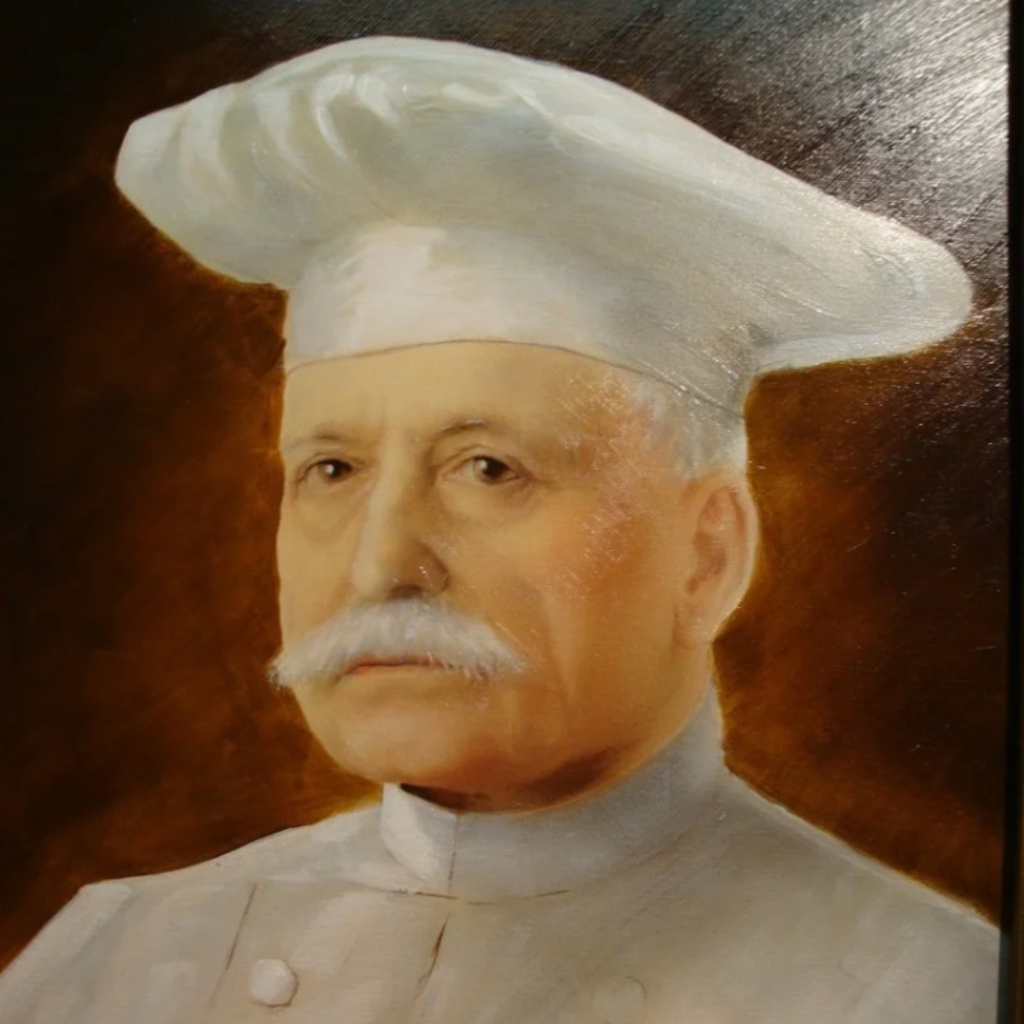
Georges Auguste Escoffier was born on October 28, 1846, in Villeneuve-Loubet, a small town in southeastern France near Nice. His family wasn’t poor, but they weren’t rich either. His father was a blacksmith. His grandmother cooked.
At thirteen, Escoffier was sent to his uncle’s restaurant in Nice as an apprentice. That was normal for the time — you didn’t go to cooking school, you went to work. By fourteen he was at Le Petit Moulin Rouge in Paris, one of the most demanding kitchens in the city, and by his early twenties he was cooking for the French army during the Franco-Prussian War.
He wasn’t a prodigy. He was just someone who showed up, learned the trade, and kept moving into bigger kitchens.
The Kitchen Escoffier Inherited
To understand why the brigade mattered, you have to understand what he was walking into.
By the 1880s, hotels and restaurants had grown large enough to serve hundreds of diners a night. The menus were enormous — some had 50 or more dishes, each prepared in a different station. If the cooks weren’t organized, the kitchen fell apart. And they usually weren’t organized.
A cook might spend the first half of the evening on sauces, then move to fish, then help with dessert. Everyone did everything. Nobody owned anything. Quality was inconsistent, service was slow, and no single person could tell you what was supposed to happen next.
Escoffier watched this for years. And then he fixed it.
The Brigade
Escoffier’s system split the kitchen into stations. Every cook had a title, a responsibility, and a boss.
The full hierarchy, from top down:
- Chef de cuisine — ran the kitchen
- Sous-chef — ran the line in the chef’s absence
- Chef de partie — ran a single station
- Saucier — sauces and sautés
- Poissonnier — fish
- Rôtisseur — roasts and grilled meats
- Entremetier — vegetables, soups, and eggs
- Garde manger — cold dishes and salads
- Pâtissier — pastry and desserts
- Commis — the junior cooks who prepped and assisted
Every station had a specific list of dishes it was responsible for. If a plate came back to the kitchen, everyone knew where to send it. If a dish was missing, everyone knew who was supposed to make it.
That’s why the brigade mattered. Not because it was elegant — because it made the kitchen predictable.
What He Did With Food
Escoffier didn’t invent French cuisine. He organized it.
The French cooking he grew up with was heavy. Dishes came with thick sauces made from reductions that took days to make. Menus were enormous. Meals were long. Presentation was elaborate and often more about showing off than about flavor.
Escoffier thought this was a problem. He believed good ingredients, prepared simply and seasoned properly, would always be better than an elaborate dish with too much going on. He cut the number of sauces from hundreds to a handful — the ones he called the mother sauces. He cut the size of menus. He cut cooking times.
This wasn’t dumbing down French cooking. It was modernizing it. He was the first person to argue that food should taste like what it is, not like what you did to it.
In 1903, he published Le Guide Culinaire, a book that collected and organized French culinary methods in a single, systematic reference. It’s still in print. It’s still used by culinary schools. It’s still the closest thing classical French cooking has to a bible.
What He Did With Kitchens
The brigade was only part of it.
Escoffier also insisted on cleanliness. He insisted on uniforms. He insisted that cooks show up on time, work sober, and treat the kitchen as a professional environment. In an era when many kitchens were run on fear and chaos, this was revolutionary.
He also cared about the people who worked for him. Historical accounts describe him organizing funds for retired cooks who had no money. He treated kitchen work as a profession that deserved respect — not just as a job you did until you could get out of it.
That’s the part of his legacy that isn’t talked about enough. Escoffier didn’t just make kitchens work better. He made them places where people wanted to work.
The Two Dishes Everyone Knows
Escoffier created hundreds of dishes. Two are still on menus today.
Peach Melba — vanilla ice cream, poached peaches, raspberry sauce. Created in the 1890s for the Australian opera singer Nellie Melba, who was performing in London at the time. It was light, elegant, and modern — exactly what Escoffier was trying to do with French food.
Melba toast — very thin, very crisp toast. Also named for Nellie Melba. She was worried about her weight, and Escoffier made her a toast thin enough to feel like nothing. It’s still served in restaurants.
Neither is a grand dish. Both show the same thing: Escoffier’s cooking was about making good food feel effortless.
Why He Still Matters
The brigade system is still used. Not exactly as Escoffier set it up — modern kitchens are smaller, and most don’t have a dedicated poissonnier or entremetier — but the idea is the same. Stations. Clear responsibilities. One person who owns each thing.
Le Guide Culinaire is still in print. The mother sauces are still taught. Peach Melba is still on dessert menus.
But the real reason Escoffier matters isn’t any of those things individually. It’s that he took a chaotic, dangerous, poorly paid profession and turned it into a craft. He gave cooks a title, a station, a uniform, and a reason to be proud of the work.
Before Escoffier, a cook was just somebody who worked in a kitchen. After Escoffier, a cook was a professional.